
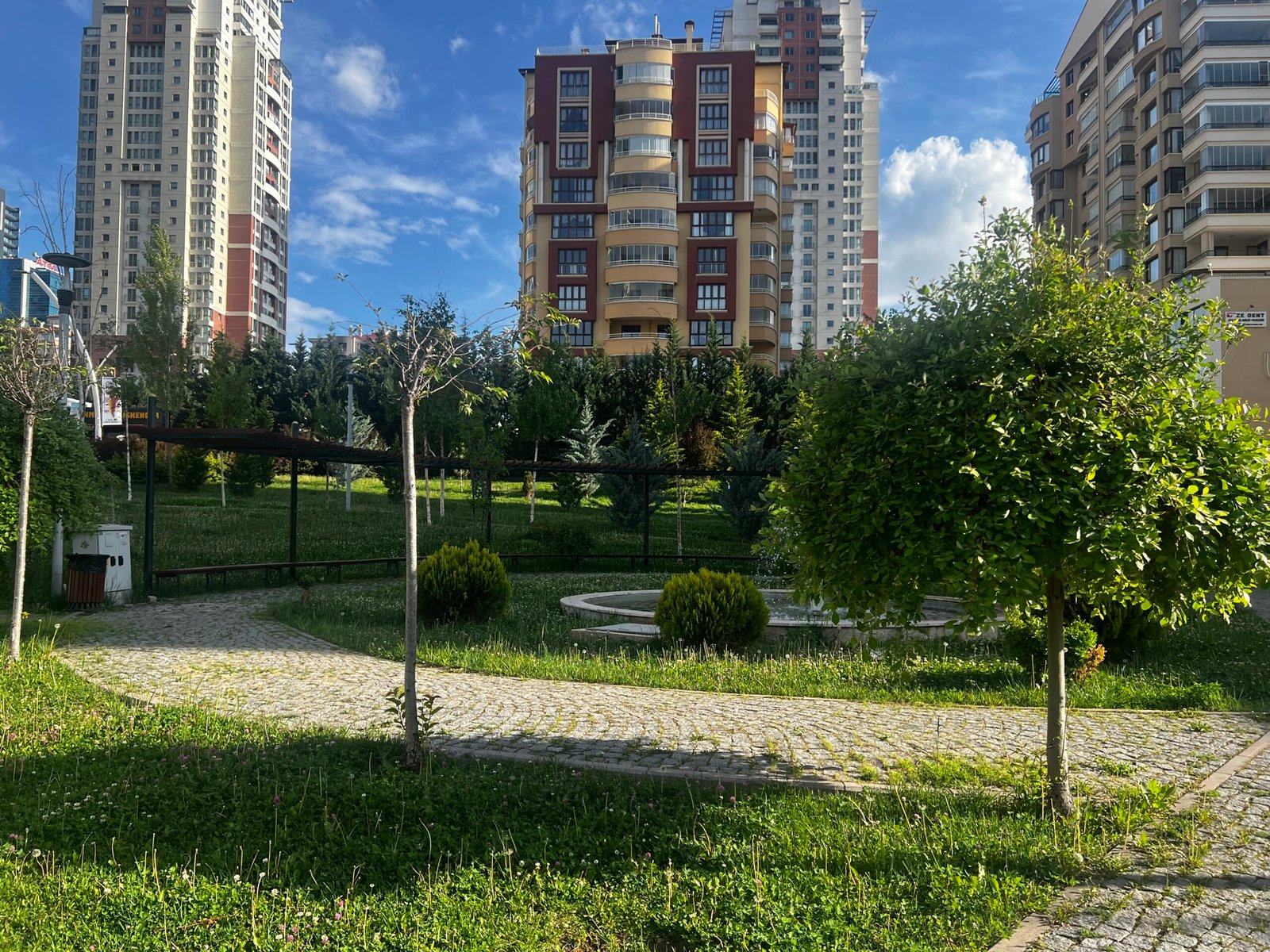

The first time I stumbled upon one of Ankara’s pocket parks, I almost missed it. Sandwiched between two apartment buildings, this little green oasis couldn’t have been larger than my childhood bedroom. Yet somehow, it contained three benches, a tiny fountain, pristine landscaping, and an elderly gentleman sipping çay, utterly engrossed in his newspaper.
Back home, such a space might have been overlooked or, worse, converted into additional parking. Here in Türkiye, it was treated as sacred – a communal living room where the neighborhood could breathe.
The Pocket Parks: Türkiye’s Social Heartbeat
I’ve since discovered that these micro-parks are everywhere in Ankara. You truly cannot walk more than five minutes without encountering one, each lovingly maintained with seasonal flowers, benches positioned for conversation, and often a small tea vendor nearby. The larger parks stretch for blocks, with families spreading out picnics, children playing ball games, and students from local universities hunched over textbooks.
What strikes me most isn’t the parks themselves but how they’re used. Unlike my default setting back home, headphones on, private bubble up-here, people rarely isolate themselves in public. Instead, these parks pulse with genuine human connection—grandmothers watching toddlers together, teenagers playing backgammon, colleagues sharing a quick çay during lunch breaks.
My attempt at journaling in one such park quickly turned into a comedy of errors. I’d arrived early to claim a picnic table for a vegan gathering a friend and I had organized, feeling quite pleased with securing some “prime real estate”—until I realized I’d positioned myself directly in the path of a lively foot volleyball game (a Turkish hybrid of volleyball and hacky sack).
THWACK! A ball bounced off my head. The players froze, horrified. I waved it off with a smile. They resumed.
THWACK! Again. More apologies. More reassurances.
THWACK! By the third strike, they finally relocated, shooting me sheepish grins. What I’d initially seen as an interruption was, in fact, a lesson: Turkish parks aren’t just green spaces—they’re stages for spontaneous community. Where I sought solitude as I waited for my friends to arrive, locals created shared joy.
Sometimes, it takes a volleyball to the head (three times!) to understand a culture’s approach to togetherness.
Trust Among Strangers: The Bus Card Phenomenon
Speaking of community, let me tell you about something that blew my American mind: the bus card pass.
Picture this: a crowded Ankara bus at rush hour. People packed so tightly you can identify the brand of cologne worn by at least three strangers. Someone boards through the rear door, far from the card scanner at the front. In America, this would mean either fighting your way forward or (let’s be honest) enjoying a free ride.
Not in Türkiye.
Instead, I watched in amazement as a young man handed his transit card to a complete stranger with a quick “Bakar mısınız?” (Would you mind?). The card then began its journey, passed hand to hand through the crowded bus, each person a momentary custodian in this chain of trust. It reached the front, was scanned by someone near the machine, and then – here’s the part that really got me – it made the entire journey BACK to its owner, without anyone pocketing it or “forgetting” to pass it along.
The first time I witnessed this dance of trust, I stood frozen in place, mouth slightly agape. A woman nearby noticed my expression and smiled knowingly. “First time in Türkiye?” she asked in perfect English. When I nodded and explained how different this was from public transportation in my hometown, she shrugged as if to say, “Why would we do it any other way?” It was such a small thing—just a bus card being passed—but it spoke volumes about the assumed trustworthiness of strangers here.
Now, I do it too. That simple act—a bus card passed among strangers—is a daily reminder that community is built on small, unspoken contracts of trust.
The Water Bottle Miracle: My Personal Story
But perhaps my favorite example of Türkiye’s community-mindedness is a personal story that still makes me shake my head in wonder.
When I first received my residence permit, I headed to the bank on Middle East Technical University’s campus to open an account. After waiting in line and filling out paperwork, I was told there was a problem with my address registration. The appointment ended with me being politely but firmly sent away to fix the issue before I could open an account.
In my distraction and disappointment, I left my water bottle behind – a treasured gift from my mother that featured an outline of Michigan and a windmill along with “Holland,” the name of the city where I grew up. I didn’t even realize it was missing until hours later, and by then, I couldn’t remember where I’d left it. Given how many offices and buildings I’d visited that day, I wrote it off as gone forever, feeling a pang of guilt about losing something with such sentimental value.
Fast forward one month. Address issue resolved, I returned to the bank. The minute I walked through the door, the same teller who had helped me previously looked up, her face lighting with recognition. She held up one finger in the universal “wait a moment” gesture, disappeared into a back room, and returned triumphantly with – you guessed it – my Michigan water bottle with the Holland windmill. I nearly cried on the spot, not just because I’d recovered a memento from home, but because someone had cared enough to save it specifically for me all this time.
Not only had they kept a forgotten item for a month (rather than tossing it out with the day’s trash), but she instantly remembered exactly who it belonged to, despite surely having helped hundreds of customers since our brief interaction.
I was speechless. In that moment, I understood something fundamental about Turkish culture that I hadn’t fully grasped before: here, being seen and remembered isn’t just for family or close friends – it extends to every human interaction.
Learning from Turkish Community Values
These experiences have reshaped how I move through the world. I’ve started learning the names of the grocery store clerks up the street, who now greet me with a smile of recognition in addition to the traditional “Hoş geldiniz!” (Welcome) when I enter. I no longer rush through transactions without making eye contact. I’ve even developed a sweet ritual with the waitstaff at the pub where I meet friends every Thursday evening—when I arrive early, they welcome me by name, usher me to our regular table, and bring my order without my having to ask, making me feel like part of their extended family while I wait for my friends to arrive.
The adjustment hasn’t always been smooth. My American instincts still rebel when taxi drivers patiently endure my fractured Turkish (*”Nerelisin?” “Erm… Michigan? Evet! Amerika!”). But last week, something shifted. When I managed to stammer out “On dokuz aydır Türkiye’deyim” (I’ve been in Türkiye for nineteen months), the driver’s face lit up like I’d recited a poem. That’s when I understood: these aren’t just conversations. They’re handshake agreements between cultures, sealed with mispronounced verbs and generous smiles.
There’s a Turkish saying I’ve come to cherish: “Bir fincan kahvenin kırk yıl hatırı vardır” – One cup of coffee has a memory of forty years. It means that sharing even a small moment of connection creates a bond that lasts. In a culture where a forgotten water bottle is safeguarded for its owner and strangers trust each other with their bus passes, I’ve learned what it means to be part of a community.
Finding Home in the Unfamiliar
Living abroad often highlights differences that can make us feel like perpetual visitors. But my time in Türkiye has revealed something profound: community doesn’t require shared history or perfect language skills—it thrives in the small, daily acts of recognition and care that transcend cultural boundaries.
The returned water bottle, the morning greetings from the workers in the METU canteen where I get my coffee and sometimes buy a meal, the saved table at a pub—these aren’t just pleasant moments but threads in a tapestry of belonging that grows richer with each interaction. What began as overwhelming culture shock has gradually transformed into a deep appreciation for how community is woven into every aspect of Turkish daily life.
For those navigating life in Türkiye or considering the journey, I encourage you to embrace these community moments. Let yourself be surprised by the kindness of strangers. Allow your schedule to bend for unexpected conversations. Notice how belonging happens not in grand gestures but in the accumulated weight of a thousand small connections.
Until we meet again in a pocket park or crowded bus,
With gratitude, curiosity, and a water bottle that found its way home,
Tiffles, Stormy, and Smokey 🐾
What moments of unexpected community have you discovered in your travels or expat life? How has living abroad changed your understanding of connection? I’d love to hear your stories in the comments below.



0 Comments